The Library of Alexandria serves as an ideal case to show how history works as evidence-based inquiry rather than legend. This introduction sets a clear aim: to sort claims that can be supported by sources from those that remain speculation.
The text explains how historians use surviving records, silences, and competing accounts to build narratives about the past. Readers will learn basic methods to evaluate popular stories about events and people without accepting dramatic tales at face value.
Focus: understanding historical reality through methods and sources, not offering a single dramatic verdict on every detail. The piece also highlights transferable skills for U.S. readers — how to read claims critically in classrooms, media, and online discussions.
Key Takeaways
- Readers will learn to distinguish supported claims from speculation using basic historical methods.
- The Library of Alexandria is a gateway topic for understanding evidence, gaps, and debate.
- Popular stories often simplify; academic work deals in probabilities and evolving interpretation.
- The article previews source types, limits of evidence, and how to evaluate viral claims.
- Skills taught are useful for critical reading in U.S. classrooms, news, and online forums.
Definition and Meaning of the Library of Alexandria
When people say “the Library of Alexandria”, they usually mean a cluster of scholarly spaces rather than one tidy building. Clarifying meaning matters because different claims target different kinds of collections, records, or institutions.
What the term referred to in ancient sources
Ancient references point to royal collections, reading rooms, and scholarly residences. The surviving record mixes descriptions of curated scrolls with mentions of state archives and teaching spaces.
Library, archive, and museum: overlapping roles
A library tended to gather texts for study. An archive kept official records. A museum stored objects and displayed them. In practice, these functions overlapped in Alexandria.
Why definitions shift over time
Definitions change as new translations, sources, or methods appear. Historians refine terms so debates focus on evidence, not on blurry labels. Precise language helps separate myth from what the record actually supports.
- Definition history: shows how terms evolve.
- Branch knowledge: labels affect what counts as a source.
- Clear definitions make later claims easier to test.
Word History and Etymology: From “Historia” to Modern Usage
C traces back to Greek roots that named a learned witness and the act of asking questions. The original terms ἵστωρ (histōr) and ἱστορία (historiā) tied inquiry to testimony and reporting.
Greek roots: inquiry, testimony, and narrative
In Hellenistic and Roman times, the sense of the term shifted toward narrative and storytelling. That change helped make accounts easier to share but also blurred how claims were tested.
How the meaning evolved into an evidence-based account
The term entered Middle English from Old French in the 14th century as a tale or story. By the 18th and 19th centuries, professional standards moved the word toward rigorous, source-based practice.
- Dictionary-style point: knowing the origin helps separate storytelling from careful inquiry.
- Dual meaning: both story and factual account persist in modern use.
- Practical link: etymology reinforces why historians weigh testimony and records.
Historical Context: Alexandria as a Center of Knowledge
Alexandria grew as a center because rulers and scholars saw organized collections as tools of power, learning, and administration. In the broader sweep of ancient history, major societies built repositories to manage texts that supported courts, temples, and officials.
Why states collected texts and records
Governments needed records for taxes, law, and diplomacy. Elite patrons funded libraries to attract talent and display prestige. Institutional collecting served governance and scholarship at once.
Exchange across the Mediterranean
Alexandria sat on trade routes where people, ideas, and written sources circulated through merchants, envoys, and visiting scholars. That movement fueled intellectual developments and local scholarly activity.
- Collections supported administration, teaching, and cultural influence.
- Patronage, copying workshops, and teachers formed a sustaining ecosystem.
- Survival of material depended on fragile choices: copying, storage, and chance.
The point is practical: institutions grow over time and leave uneven traces. Understanding that pattern clarifies the Library’s likely role and prepares readers for where the surviving evidence is strong or thin.
What Historians Can Actually Claim: Evidence, Limits, and Certainty
Scholars must weigh surviving documents and material traces to decide which claims about Alexandria rest on solid ground. That process separates well-supported statements from plausible but unproven ones.
What counts as a historical source
Primary texts, inscriptions, coins, and archaeological finds all count as sources. Later authors can also serve as sources, but their value depends on proximity to the events and access to original material.
Gaps, silences, and degrees of certainty
Absence in the record does not prove absence in the past. Some significant events left weak traces or were deliberately lost. Historians communicate degrees of certainty—what is known, what is likely, and what remains unknown.
- Practical point: when a source is late or contradictory, responsible study labels claims as probable or speculative.
- Limits: not all evidence is equally reliable; cross-checking reduces error without erasing uncertainty.
- Takeaway: clear boundaries help readers tell plausible reconstructions from overreach about the Library’s role and events.
Sources for the Library of Alexandria: Primary, Secondary, and Tertiary
Assessing what survives from Alexandria starts with sorting sources by when and how they were created. This classification guides any careful study and frames scholarly debate.
Primary sources in practice
Primary sources originate during the period studied: inscriptions, papyri, coins, and archaeological remains. They offer direct access to the past but can be incomplete or biased.
Secondary and tertiary materials
Secondary sources interpret primary evidence. Scholarly books and articles debate meaning and method, contributing to historiography.
Role depends on the question
A work can be primary for one inquiry and secondary for another. For example, a modern scholar’s book is a primary source when studying modern interpretation, but a secondary source for ancient events.
Where records live and special notes
- Archives, libraries, and museums (including digital collections) are gateways to physical and digitized records.
- Oral history matters for many topics but is limited for ancient Alexandria; it rarely replaces written or material evidence.
- Precise language helps: “a history” is a noun meaning an account, distinct from the discipline and from the past itself.
Historical Method and Source Criticism Applied to Alexandria
Source criticism turns fragments into a cautious, testable account. It gives readers a clear checklist for assessing claims about Alexandria rather than accepting dramatic stories at face value.
External criticism: checking origin and transmission
External criticism asks who wrote a text, when it was produced, and how it reached modern readers. It looks for later edits, copyist errors, and possible forgeries across time.
Internal criticism: meaning, bias, and omissions
Internal criticism examines what the author actually claims and why. It tests accuracy by spotting bias, incentives, or obvious omissions that reshape a report.
Cross-checking accounts
- Compare independent sources that describe the same event.
- Prefer convergence across different genres (inscription, papyrus, author).
- Be wary when a single late text drives an entire narrative.
Building synthesis from fragments
Historians weigh reliability and combine corroborated details into broader explanations. That disciplined mixing of evidence produces responsible reconstructions and informs ongoing debates in historiography and modern histories.
Recorded History vs. Prehistory: Why Writing Matters for This Topic
Because the Library’s core activity centered on texts and copying, it belongs to the era of recorded sources. The subject depends on surviving scrolls, references in later authors, and institutional practices tied to written media.
Why the Library belongs to recorded history
The Library is inseparable from the production and circulation of written material. That link gives historians direct access to the record and lets scholars analyze specific written sources rather than only material echoes.
How archaeology can complement written accounts
Archaeology supplies context: building remains, pottery, and city layouts show how books were stored, copied, and used. Such finds illuminate urban developments and institutional scale when texts are sparse or contested.
- Writing changes what survives and how confidently one can reconstruct the past.
- Archaeology adds evidence about space and daily practice but rarely proves a dramatic story alone.
- Defining a period and time frame helps integrate material and textual clues into a careful study of past developments.
Method matters: the same evidentiary standards used for other studies of the past should guide work on Alexandria. Combining texts and archaeology produces the most reliable reconstructions of this unique institution.
Common Myths About the Library of Alexandria
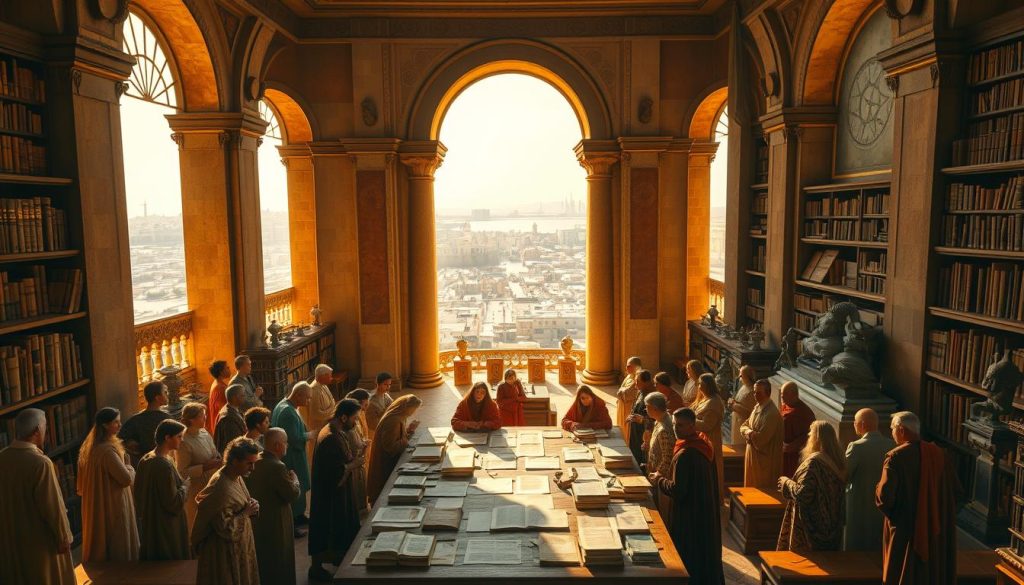
Many popular accounts compress the Library’s complex past into neat, dramatic episodes that are easy to retell.
The “single catastrophic fire” story
The image of one huge blaze that destroyed all books is powerful. It makes a clean event out of a long series of losses.
Evidence points to multiple damaging episodes over centuries, not a single, decisive event. Treat the fire tale as a hypothesis to test, not as settled fact.
The myth of a complete, universal collection
Claims that the Library held every book in the known world use superlatives that rarely match documentary evidence.
More likely, collections focused on select works and grew through copying and purchase. Superlative language signals storytelling rather than strict documentation.
Misconceptions about a sudden end to ancient knowledge
Knowledge transmission usually changes gradually. Copies existed across regions, and scholars moved between centers.
A sudden, total end to ancient learning is unlikely. Losses were uneven and often local, not universal.
Why simplified stories spread in popular culture and classrooms
Simplified accounts suit classroom time, dramatic narratives, and media that prefer single causes. A vivid tale is easier to remember than complex evidence.
For example, a catchy idea about a single disaster can become “common knowledge” when repeated in textbooks and documentaries without citing primary sources.
- Myths as testable claims: Treat each story as a proposal to check against sources.
- Use skepticism: Favor corroboration from texts, inscriptions, and archaeology.
- Teaching moments: Myths reveal how history can slide into memorable story when evidence is simplified.
Separating Myth from Reality: What the Historical Record Supports
Not every appealing story survives contact with the record; careful reading separates supported claims from speculation.
What can be stated with confidence versus what remains speculative
Scholars label claims as supported, plausible, or not currently supported based on the quality and number of sources. Strong conclusions rest on direct evidence or multiple independent accounts.
How reinterpretation happens when new evidence appears
New manuscripts, improved dating, or a fresh reading of an old text can change what the record supports. Reinterpretation is routine; it refines, rather than overturns, well-corroborated findings.
Why “a history” is a representation, not the past itself
Readers should grasp that a history and the history noun are constructed accounts assembled from evidence. Past events remain fixed; narratives change as sources are reassessed.
- Look for explicit sourcing and degrees of certainty.
- Avoid absolute claims that ignore gaps in the record.
- The aim is alignment with sources, not debunking for sport.
Historiography: How Different Schools of Thought Interpret Alexandria
Competing scholarly schools offer distinct maps for reading the same fragmentary record from Alexandria. Historiography is the study of how accounts are made and why interpretations shift.
Positivist approaches and evidence
Positivists narrow claims to what survives in direct sources. They prize verifiable evidence and resist broad narratives when documentation is thin.
Annales-style long-term developments
Annales-influenced scholars focus on slow social and economic changes. They trace institutional developments, literacy patterns, and everyday practices over centuries rather than single events.
Marxist and political readings
Marxist and political lenses foreground patronage, class interests, and state power. These readings show how economic forces shaped what was collected and preserved.
Postmodern cautions
Postmodern critics warn against grand narratives and stress interpretive choices. They remind readers that any reconstruction involves selection and framing.
- How to spot lenses: check if an author privileges documents, social trends, power, or narrative critique.
- Recognizing the lens clarifies the claimed role of the Library in broader debates about knowledge.
Periodization and Time: Placing Alexandria Within Ancient, Medieval, and Modern History
Period labels act like lenses: they shape which questions scholars ask about Alexandria and which sources they value. Periodization divides long stretches of time into named spans—ancient, medieval, early modern, and modern—to make patterns visible.
Ancient frameworks and their emphasis
Ancient history frameworks focus on states, empires, writing, and institutions. Scholars ask about administrative records, libraries, and how texts circulated in a given century.
This lens privileges documentary evidence and institutional change. It helps test claims about the Library’s role in knowledge production during specific centuries.
Medieval transmission and early modern reshaping
Medieval history approaches track how texts moved, were copied, or vanished across long stretches of time. Later readers in Byzantium and the Islamic world kept or altered accounts that reached Europe.
In the early modern period, print culture and scholarship recast ancient anecdotes. Early modern editors summarized and sometimes amplified stories, changing how later readers perceived particular centuries.
Modern retellings and American contexts
Modern history narratives in the United States often compress timelines for classroom clarity. Textbooks and popular books may tie the Library’s fate to a single dramatic century, which can mislead readers.
- Ask which period lens is used: it clarifies scope and evidence.
- Check century claims: they should match documentary support.
- Watch for anachronism: modern interpretations can project later values onto earlier centuries.
Why the Library Matters to the Study of History as a Discipline

The Library of Alexandria is more than an ancient curiosity; it is a compact lesson in method. As a focused case, it shows how scholars combine fragmentary records with interpretive frameworks to make careful claims.
History as social science vs. humanities: where Alexandria fits
Some theorists treat the field as a social science, others as a humanities branch, and many call it a hybrid. Alexandria requires both approaches: systematic data about texts and institutions, and interpretive work that builds meaning from gaps.
What the case teaches about evidence, interpretation, and narrative
The case trains students in how to read evidence, weigh competing accounts, and avoid letting a powerful narrative outrun the sources.
- Study skills: assess provenance, date, and bias.
- Evidence habits: prefer corroboration across types of sources.
- Guide for judgment: label claims as supported, plausible, or speculative.
Ultimately, Alexandria helps the subject of histories show its public value. It teaches transferable skills: evaluating claims, weighing evidence, and spotting interpretive choices useful beyond a single case.
Pseudohistory and Popular Claims: Red Flags to Watch For
A quick checklist can help people spot when attractive stories about the Library ignore key sources and inflate an account.
Selectively ignoring evidence and overconfident certainty
Selective use of evidence is a major red flag. A post that highlights one dramatic quote while ignoring broader sourcing problems is suspect.
Overconfident certainty is another warning. Claims that omit limits of the record or the age of sources often oversell a weak case.
Ideological agendas and distorted accounts
Watch for narratives that turn Alexandria into a symbol to attack or glorify modern groups. When the argument serves an agenda, scholars call key facts into question.
How to evaluate viral claims using basic source criticism
- Check authorship, date, and transmission of cited sources.
- Look for corroboration across independent texts or material evidence.
- Ask whether the source actually says what the viral account claims.
- Prefer arguments that name limits and competing interpretations.
This short guide helps readers assess popular topics quickly and judge claims about ancient collections with clearer standards.
Related Terms and Topics Readers Commonly Search
Users frequently confuse lived testimony and archival evidence when looking for related topics.
Oral evidence versus written sources
Oral history captures memory, community experience, and lived practice. It can preserve voices that never made it into archives.
By contrast, written sources create a durable record that historians can date, cite, and cross-check. Each type has strengths and limits for ancient topics.
Medical, family, and institutional records
Medical history refers to clinical notes or patient records used for care and research. In everyday U.S. use, it helps doctors make decisions.
Family history documents ancestry, health risks, and stories passed down in households. It is practical, not always academic.
Institutional records bridge these uses: organizations generate documents that later serve as evidence about past actions.
Alternate history, brief history, and search intent
Alternate history is a creative genre that reimagines outcomes. It is not a substitute for academic inquiry.
Brief history is a shorthand format useful for quick orientation but it omits debates, uncertainties, and source limits. Treat summaries as starting points and check sourcing when topics are contested.
- Map search terms to their function: practical record, memory source, or scholarly evidence.
- Prefer corroboration when a claim affects interpretation of the past.
- Use skepticism with dramatic summaries and respect the limits of each source type.
Examples of “History” in Real-World Usage and Why Precision Matters
In everyday speech the term works in three ways: a university subject, the sequence of past events, and a written account that interprets those events.
History as a subject of study vs. past events
Students say things like “I studied history at Cambridge University” to name a subject taught in class.
By contrast, calls about the past mean actual past events, as in “those past events shaped the city.”
“A history” as an account or record
A phrase such as “a brief history of the Internet” shows the noun used to label a produced account, not the past itself.
Clear examples help: they show how statements differ and reduce confusion that fuels myths about Alexandria.
- Example sentences clarify whether a claim cites a single text or consensus.
- Examples represent usage patterns from Cambridge University Press and Merriam-Webster style guides.
- Readers should ask: does the speaker mean the academic subject, the past, or a specific account?
Conclusion
The lasting lesson is that claims about Alexandria gain force only when built from verifiable sources and cautious reasoning.
Readers should expect the record to yield partial answers. Careful inquiry favors graded conclusions over dramatic certainty.
Historiography matters: different schools shape which developments and periods get attention and how events are framed. Words and meaning steer interpretation, so precision reduces distortion.
Use this practical guide: ask for sources, check dates and transmission, seek corroboration, and resist overconfident narratives. That practice helps people judge claims about the past and the preservation of knowledge in any century.
In short, Alexandria teaches a durable principle: when a story seems too tidy, return to the evidence and method that make sound history possible.
FAQ
What does the term "Library of Alexandria" actually refer to in ancient studies?
The phrase designates a network of intellectual institutions tied to the royal quarter in Alexandria, Egypt, during the Hellenistic period. It includes a major library or libraries, an associated research institution often called the Mouseion, and related archives and collections used by scholars, scribes, and patrons. Evidence comes from literary references, papyri, and archaeological context rather than a single surviving institutional plan.
How does one distinguish a library from an archive or a museum in the ancient context?
In antiquity, a library primarily collected books and rolls for reading and copying; an archive preserved administrative and legal records; a museum or Mouseion functioned as a research and cultural center hosting scholars and performances. The lines blurred: the Mouseion housed collections used for study, and some archives also served as reference holdings for researchers and officials.
Why do definitions of the Library change over time among scholars?
Definitions shift because new textual finds, papyrological evidence, and reinterpretation of ancient authors alter the evidence base. Historiography, archaeological discoveries, and evolving methodological standards—such as stronger emphasis on provenance and material culture—lead researchers to revise earlier generalizations and to refine what counts as the institution.
What are the Greek linguistic roots behind study, narrative, and inquiry?
Key Greek terms include historia (inquiry or account), logos (word, reason, or study), and mneme/mnēmē (memory). These roots shaped how writers framed the work of chronicling events and preserving texts. Over time, these words helped shift emphasis from storytelling to systematic collection and critique.
How did the meaning of the word for scholarly account evolve from story to evidence-based record?
Early uses emphasized eyewitness report and narrative. As rhetorical, legal, and archival practices matured, authors and institutions adopted standards for source citation, cross-checking, and transmission—transforming a focus on tale-telling into methods that privilege documentary support and critical evaluation.
Why did major ancient societies create institutions to gather texts and records?
Political elites, religious bodies, and intellectual patrons collected texts to consolidate cultural authority, support administration, educate officials, and enhance prestige. Collections advanced scholarship, preserved legal and medical knowledge, and promoted economic and diplomatic memory across Mediterranean exchange networks.
What counts as a primary source for studying Alexandria’s collections?
Primary sources include surviving papyri, inscriptions, contemporary accounts by authors such as Strabo and Plutarch, and archaeological remains tied to libraries or the royal quarter. A primary source provides direct or near-contemporary evidence for the institution, its holdings, or its staff.
How do secondary sources and interpretation shape understanding of the Library?
Secondary works synthesize and interpret primary materials, applying historiographic frameworks and critical methods. They reveal scholarly debate over chronology, organization, and loss. Interpretations reflect changing methodologies—textual criticism, archaeology, and comparative institutional history—which can produce competing reconstructions.
Can the same document be primary for one question and secondary for another?
Yes. A papyrus fragment is primary evidence for the text it contains, but it may be a secondary witness when used to trace later editorial practices or reception. Context and research question determine the source’s role in an inquiry.
What is external criticism and why does it matter for Alexandria studies?
External criticism assesses authenticity, authorship, date, and transmission—verifying whether a text or inscription genuinely belongs to the period or person claimed. It prevents reliance on forgeries, misattributions, or misdated materials and is essential to producing reliable reconstructions of institutional history.
What is internal criticism when evaluating ancient accounts?
Internal criticism examines meaning, reliability, omissions, and bias within a text. It asks what the author intended, which voices were excluded, and how rhetorical aims shaped presentation. This step helps historians weigh claims about organization, purpose, and the scale of collections.
How do historians cross-check fragmentary accounts to reduce distortion?
Scholars compare independent testimonies, match literary references with material finds, analyze provenance and paleography of manuscripts, and use interdisciplinary evidence—from papyrology to archaeology and epigraphy—to test consistency and fill gaps without inventing unwarranted detail.
Why is the Library of Alexandria part of recorded rather than prehistoric study?
The institution belongs to recorded eras because contemporaneous written sources, inscriptions, and documentary fragments survive that directly relate to its operations, people, and reputation. Writing enables historians to trace institutional practices and intellectual networks in ways not possible for prehistoric periods.
How can archaeology complement written accounts about Alexandria?
Excavations yield architectural remains, storage features, reading spaces, and material culture—lamp fragments, classification implements, or tags—that corroborate or challenge textual descriptions. Archaeology supplies physical context and can date phases of activity overlooked in literary sources.
Is the story of a single catastrophic fire that destroyed all texts accurate?
No. The evidence does not support a single, all-consuming blaze. Contemporary records suggest multiple episodes of loss across centuries—political turmoil, administrative neglect, and localized fires—and gradual dispersal or destruction rather than one decisive event.
Was the Library ever a universal repository of every book in the ancient world?
That claim is exaggerated. While Alexandria attracted many works and produced significant acquisitions, logistical, linguistic, and political limits constrained holdings. The institution curated extensive but selective collections shaped by patronage, copying practices, and scholarly priorities.
Did ancient knowledge end abruptly with the Library’s decline?
No. Scholarly activity and textual transmission continued in other centers—Antioch, Pergamum, Rome, and later Byzantine and Islamic libraries. Losses affected particular texts and traditions, but intellectual exchange persisted through copying, translation, and reuse over centuries.
What can historians state with confidence about Alexandria’s scholarly role?
Confident claims include that Alexandria served as a major intellectual center in the Hellenistic and Roman worlds, hosted organized scholarly activity through a Mouseion, and amassed notable collections that influenced medicine, astronomy, literary criticism, and library practices across the Mediterranean.
Why do reinterpretations of the Library occur when new evidence appears?
New papyri, inscriptions, or archaeological layers can confirm, nuance, or overturn earlier readings. Reassessment follows better dating, clarified provenance, or fresh methodological approaches—prompting scholars to revise models to fit the expanded evidence base.
How do different historiographical schools treat Alexandria?
Positivist approaches emphasize documentary verification; Annales-style studies place the institution within long-term social and economic structures; Marxist readings highlight patronage and power dynamics; postmodern scholars caution against grand narratives and urge attention to silences and marginal voices.
How is Alexandria situated in ancient, medieval, and modern period frameworks?
Ancient frameworks focus on Hellenistic patronage and early Roman integration. Medieval scholarship traces transmission through Byzantine and Islamic translators. Modern scholarship, including work at Cambridge University Press and other academic centers, examines reception, myth-making, and national narratives shaping contemporary retellings.
Why does the Library’s story matter for the discipline of study itself?
The case illuminates how evidence, interpretation, and narrative craft interact. It teaches rigorous source criticism, archival practices, and how institutions influence knowledge production—lessons relevant across social science and humanities research and for curatorial decisions in archives and museums.
What red flags indicate pseudohistorical claims about Alexandria?
Warning signs include selective citation, overconfident certainty without primary evidence, ideological framing that ignores counter-evidence, and viral claims lacking peer-reviewed support. Good practice checks provenance, cross-references sources, and seeks scholarly consensus.
How should readers evaluate viral or sensational claims about the Library?
Readers should ask for primary evidence, trace citations to original texts or papyri, consult recent scholarship and reputable university presses, and apply basic source criticism: who wrote the claim, when, for what audience, and on what documentary basis?
What related terms should readers explore to broaden understanding?
Useful topics include oral history versus written sources, archival practice, historiography, medical and family records in institutional collections, and how brief or popular accounts differ from scholarly monographs and specialized articles.
How does precision in language affect discussions about the ancient library?
Clear terms—distinguishing collection, archive, museum, Mouseion, and library—prevent conflation. Precise dating, source classification (primary/secondary), and careful use of terms like “a history” versus “the past” improve argument quality and public understanding.