The Islamic Golden Age stands as a defining chapter in global history. Baghdad acted as a hub where ideas moved, merged, and generated lasting developments that shaped science, art, and trade.
Readers will see why scholars call Baghdad an “intellectual capital.” The city hosted libraries, madrasas, and translation centers that helped knowledge travel across regions. The guide previews scholarship, institutions, and the wide circulation of learning.
This article maps the era in the record of the past and outlines historical methods used to study key events. It covers daily life, translation work, science and medicine, math and astronomy, arts, and trade networks.
The focus stays on what the historical record can support while noting debates and uncertainty. It also links the era to how Americans see learning and cultural heritage in classrooms, museums, and media today.
Key Takeaways
- Baghdad was a central node for knowledge exchange during this important period.
- Institutions like libraries and translation houses drove major scientific developments.
- The article prioritizes evidence-based accounts and notes open debates.
- Readers will get a roadmap: methods, daily life, science, arts, and trade.
- The era still shapes modern teaching, museums, and cultural narratives in the U.S.
Why the Islamic Golden Age Matters to History Today
The word history has two common meanings. It can mean the past itself. It can also mean the academic study that uses evidence to explain that past.
Defining the meaning of the term helps readers spot the practical difference between telling stories and testing information. A careful study checks documents, dates, and sources. A history — as a noun — can be a constructed narrative that changes when new evidence appears.
Baghdad’s legacy matters because it shaped systems for preserving and sharing knowledge. Libraries, patronage networks, and translation schools made learning scalable. These systems still influence how scholars work and how the public learns about the past today.
- Study vs. story: test claims against sources.
- Constructed narratives: “a history” can change with new finds.
- Lasting methods: preservation and cross-cultural inquiry endure.
This section aims to improve readers’ historical literacy so they evaluate claims about the past with more rigor.
Baghdad as an Intellectual Capital of the Medieval World
When people, markets, and institutions gather, ideas spread faster and take root.
Why cities become hubs for learning and exchange
Major cities attract talent because they offer dense populations, patronage, and markets for books. Institutional support — libraries, schools, and courts — creates steady demand for study and teaching.
Social networks reward scholarship. That encourages more copying, debate, and publication. Over short times, small gains compound into broader cultural shifts.
How Baghdad linked people, texts, and traditions
Baghdad sat at trade routes and bureaucratic centers. It drew a diverse community of scholars and patrons. Scribes, book markets, and scholarly letters formed a resilient media ecosystem.
- Dense urban life created audiences for learning.
- Translation and patronage accelerated technical and literary developments.
- Cross-regional contact moved practical techniques and abstract knowledge.
Baghdad’s rise was a process shaped by governance and connectivity. Its influence shows up in medicine, astronomy, literature, and the study of the past.
Placing the Islamic Golden Age in the Record of the Past
Dividing long spans into periods makes it easier to link events to broader developments. Periodization is a tool that helps historians frame the Islamic Golden Age within post-classical history without pretending the boundaries are exact.
Periodization and its limits
Scholars note affinities with earlier cultures. Greek, Persian, and Indian texts entered the medieval intellectual world through preservation and reinterpretation. That continuity ties this period to ancient history while also showing new institutional growth.
Events and long-term change
Historians connect discrete events to sustained developments such as expanded libraries, revised scientific methods, and formal schools. Small innovations often compound over time into systemic change.
What recorded history captures—and misses
The record usually means manuscripts, inscriptions, and official documents. These sources often emphasize elite voices and public institutions.
Loss, copying choices, and translation shape what survives. Gaps do not mean nothing happened; they mean the evidence is incomplete. Readers should weigh claims against the limits of recorded history.
How Historians Reconstruct This Period
Reconstructing the past starts with clear questions and a steady method. Scholars frame a problem, gather sources, and test interpretations against evidence. That disciplined way helps justify claims about medieval Baghdad.
The historical method: questions, evidence, and interpretation
The method moves from specific questions to primary documents, then to interpretation. Historians make arguments transparent about limits and uncertainty. Good work shows which claims rest on strong evidence and which remain open.
Primary sources vs. secondary sources
Primary sources are materials created during the era: manuscripts, chronicles, legal texts, and letters. Secondary sources are later analysis by scholars who synthesize those materials. Both types supply different kinds of information.
Source criticism and archives
Source criticism checks authenticity (external) and meaning (internal). Researchers test authorship, alterations, bias, and omissions. They read documents in political and social context to avoid anachronism.
- Triangulation: compare multiple accounts when the record is thin or contradictory.
- Museum and library catalogs shape what is accessible; preservation affects what survives.
- Responsible interpretation is evidence-led and clear about debate and uncertainty.
People, Community, and Daily Life in Abbasid Baghdad
Daily rhythms in Baghdad—market stalls, study halls, and family homes—fed the city’s vibrant learning culture.
Scholars, practitioners, and urban professions
Scholars, translators, physicians, artisans, patrons, and book professionals formed a dense social web. These people kept texts moving and debates alive.
Networks and a single person’s path
Opportunity often depended on teachers, patrons, guild-like circles, and reputation. A person’s career grew through introductions and letters, not isolation.
Family, schooling, and day-to-day neighborhoods
Family expectations shaped schooling, apprenticeships, and literacy. Households hired tutors and sponsored study, shaping who read and who taught.
Markets, mosques, and private study rooms set the pace of day-to-day life. Those spaces decided who met whom and how ideas spread.
- Local hubs: bookshops and madrasa courts concentrated resources.
- Competition: urban density sharpened debate and standards.
- Access: community ties determined who reached texts and patronage.
Everyday experiences in Baghdad made translation movements and scientific institutions practical, rooted in social and economic reality.
Knowledge Transfer and Translation Movements
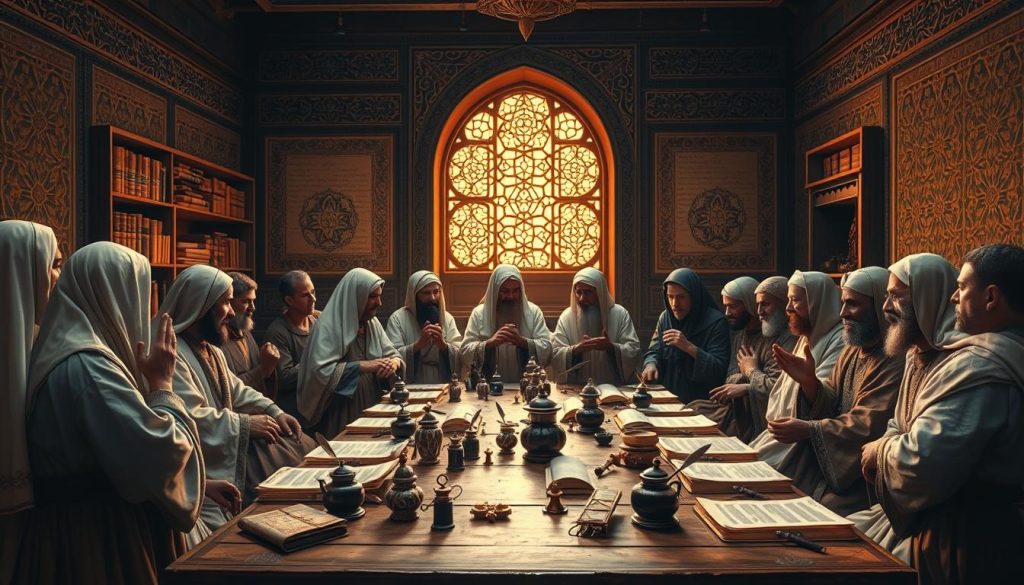
Translators acted as mediators, negotiating technical terms and cultural assumptions. They treated translation as a practical craft and an intellectual project that preserved texts and expanded their meaning.
Translation revived works of ancient history and brought ideas from the past into new debates. Copying often included commentary, correction, and local adaptation.
Across time, translators created a shared way of handling technical vocabulary. That consistency helped scholars test methods and build standards in medicine, math, and astronomy.
Cross-cultural learning linked languages and regions. Teams negotiated terminology, legal and medical phrases, and philosophical concepts so texts remained useful in new settings.
- Practical process: copying, glossing, and commentary preserved content.
- Intellectual process: adaptation changed emphasis and led to debate.
- Why context matters: terms can shift context and thus alter conclusions.
Once texts circulated, they seeded long debates and new commentaries that outlived any single court or city. Translation became a durable route for transferring knowledge across places and times.
Science, Medicine, and Medical History Breakthroughs
Clinical work and institutional care in medieval cities created feedback loops that improved medical methods over time.
Hospitals, clinical observation, and the rise of systematic inquiry
Hospitals in Baghdad functioned as more than charity sites. They were teaching centers where doctors recorded symptoms and outcomes.
That practice turned isolated cases into repeatable lessons and produced reliable medical information for students and colleagues.
Pharmacology, surgery, and public health in context
Urban density and long-distance trade increased demand for drugs, surgical tools, and public health measures.
Pharmacology advanced as physicians compiled materia medica from traded substances. Surgery improved where training and instruments were available.
How medical knowledge traveled and evolved
Knowledge moved through translated texts, apprenticeships, travel, and letters between physicians.
Each transfer adapted treatments to local resources, so information changed while core techniques persisted.
- Credible evidence: historians compare texts, case notes, and outcomes to judge claims in medical history.
- Social context: health systems reflect social values, resources, and political priorities.
- Past events: outbreaks and reforms often create clear documentary traces that reveal rapid developments.
Mathematics, Astronomy, and Measuring Time
Precise calendars and careful observations turned charted skies into tools for daily life and long-term planning.
Calendars, chronology, and the practical science of timekeeping
Calendars and chronology gave administrations, markets, and religious communities a common framework. This shared schedule guided taxation, travel, and the course of scholarly work.
Practical timekeeping supported social coordination across a broad period and helped officials set deadlines and rituals.
Observatories, instruments, and shared scientific standards
Observatories and instruments converted theory into measurement. Equipped with astrolabes, armillary spheres, and sighting devices, teams recorded data that could be compared across places.
- Standards: repeated observation produced more reliable records.
- Training: instruments required skilled mathematics and institutional support.
- Applications: better computation improved calendars and navigation.
Mathematical techniques fed developments in calculation, prediction, and record-keeping. As examples, refined tables and observational logs allowed later generations to reassess earlier scientific claims and build cumulative knowledge.
Literature, Art, and the Cultural Heritage of the Era
Literary and visual expressions from Baghdad reveal how communities shaped collective memory. These cultural products—poems, tales, illuminated manuscripts, and urban decorations—kept social ideals alive and shaped later understandings of the past.
Storytelling, books, and the “historia” tradition
Historia emerged as a hybrid: narrative skill plus inquiry. It preserved lived experiences through engaging stories that also aimed to explain causes and meaning.
Readers should treat those narratives as sources that mix memory, moral aims, and fact. Careful reading separates rhetorical purpose from factual claims.
Architecture, calligraphy, and visual culture as evidence
Physical art—buildings, inscriptions, and calligraphy—acts as a public record of patronage, belief, and technical skill. Materials and stylistic choices reveal networks of funding, workshop practices, and cultural identity.
- Books functioned as objects: copied, bought, and collected in markets and libraries.
- Design and script show where tastes moved and which patrons supported certain works.
- Art and literature form a lasting cultural heritage that requires disciplined interpretation.
Trade, Travel, and the Wider World Beyond Baghdad
Merchants, pilgrims, and scholars used the same routes, turning trade lanes into pathways for innovation. Those corridors moved goods and also transported techniques, texts, and practical developments that reshaped local practice.
Exchange routes as engines of change
Durable routes linked markets and learning centers across many regions. That network made Baghdad influential beyond its walls by creating interdependent urban systems.
How travel accounts expand the record
Travel writing and the travel account add details that official documents miss: routes, prices, customs, and encounters. These accounts enrich the record but require careful source criticism.
- Strengths: firsthand routes, merchant costs, social encounters.
- Limits: exaggeration, narrow perspective, occasional bias.
Connecting communities through a shared course of events
Political shifts, migrations, and commercial booms altered who met whom and what circulated. Exchange networks explain why some innovations spread quickly while others stayed local or vanished.
Historiography and Debates About Interpreting the Golden Age
Classifying the study of past happenings affects method, evidence, and the claims historians make. Historiography is the study of how the past is written and how methods shape conclusions.
Disciplinary debate: Some treat this inquiry as part of the humanities, focused on narrative and meaning. Others emphasize social science methods that test hypotheses with quantitative or comparative data. Many scholars adopt a hybrid approach, blending close textual reading with broader social analysis.
Why it matters: The label influences what counts as strong evidence and which questions get asked. That choice changes which sources are highlighted and which interpretations seem persuasive.
Why narratives change and how myths form
New information, fresh manuscript finds, or reinterpreted texts often revise established narratives. Reinterpretation is normal and improves accuracy rather than shows weakness.
Myths spread when the meaning of evidence is flattened or context is removed. The word “Golden Age” helps signal achievement but can also hide conflict, inequality, or decline.
Guidelines for evaluating popular claims
- Check sourcing: transparent citation and primary documents matter.
- Look for engagement: does the account address counterevidence?
- Note language: careful qualifiers about uncertainty are a good sign.
- Assess context: facts gain meaning when placed in social and political frames.
From Baghdad to the United States: Modern Relevance and Public Memory
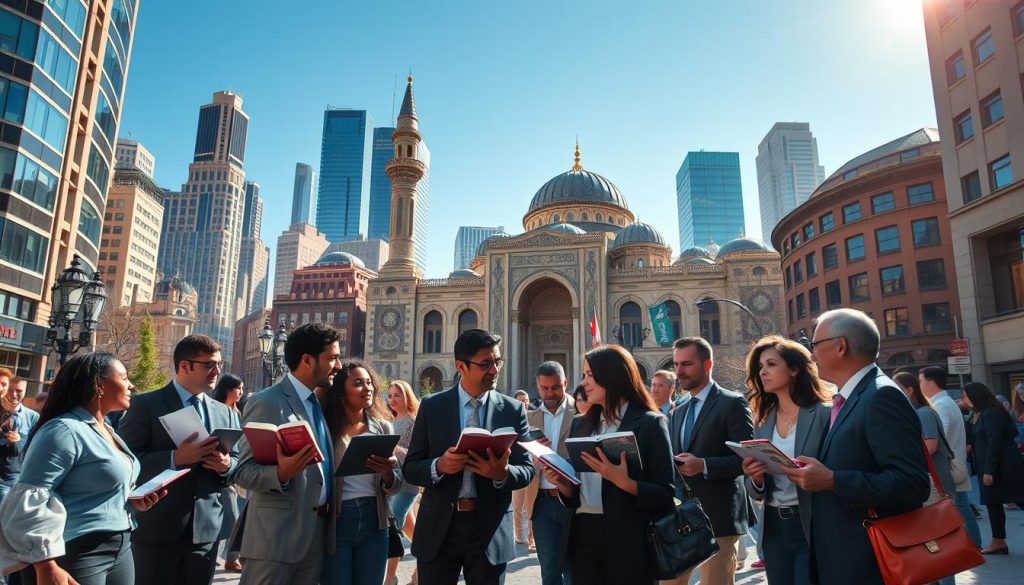
Public memory in the United States treats Baghdad’s achievements as part of a global story that shapes how people learn today.
Education often highlights scientific transmission and interconnectedness. School curricula include examples of algebra, translation work, and medical texts as ways to teach how knowledge moves across borders.
How museums and media shape understanding
Museums, documentaries, and popular books frame what audiences think they know. Good exhibits use transparent sourcing and clear labels. That helps visitors separate evidence from interpretation.
Why cross-cultural literacy matters
Understanding the past as exchange—not isolation—builds cross-cultural literacy. Students who see examples of shared methods are better prepared to read modern debates and events fairly.
Using the past responsibly
Pseudohistory distorts evidence by omitting sources or stretching timelines. Responsible public history uses credible scholarship, cites primary documents, and corrects mistakes when new research appears.
- Practical checks: verify author expertise, citations, and use of primary sources.
- Watch for: selective timelines, political agendas, and broad claims without citations.
- Best practice: transparency, clear distinction between fact and speculation, and prompt correction of errors.
Heritage is strengthened when interpretation respects complexity and shows how events connect across time and place.
Conclusion
Baghdad’s Islamic Golden Age shows how institutions and communities turn local skill into lasting change.
The city’s libraries, madrasas, and markets sustained scholarship across a long period and spread practical advances in science, medicine, math, art, and trade.
Understanding this chapter of history requires method, careful evidence, and humility about gaps in the record. Studying connected events over time reveals relationships often lost when topics are treated separately.
Readers are encouraged to approach the past with curiosity and rigor, favoring credible sources over simple stories that erase debate and diversity.
Stronger public literacy about the past improves conversations about culture and innovation today and helps people see shared human progress as cumulative rather than accidental.
FAQ
What timeframe does the Islamic Golden Age cover and why is Baghdad central to it?
Scholars typically place the Islamic Golden Age roughly between the 8th and 13th centuries. Baghdad became central because it served as a political, economic, and cultural hub under the Abbasid Caliphs, hosting major institutions like the House of Wisdom where scholars, translators, and patrons converged to study texts, sciences, and philosophy.
How does the study of the past differ from the past itself?
The study of the past uses methods, interpretation, and evidence to reconstruct events, institutions, and experiences. The past itself consists of lived events and choices that cannot be directly recovered. Historians work with surviving documents, material culture, and accounts to create coherent narratives while acknowledging gaps and uncertainty.
In what ways does the Islamic Golden Age still matter to modern society?
This era contributed foundational advances in mathematics, astronomy, medicine, and literature that shaped later European and global knowledge. Institutions, translations, and networks from that time enabled cross-cultural learning and the preservation of ancient texts, influencing education, science, and cultural heritage today.
Why do cities become centers for ideas, media, and scholarship?
Cities concentrate resources: markets, patrons, information flows, diverse populations, and specialized craftsmen. That density fosters institutions—libraries, schools, hospitals—and networks that accelerate the production, preservation, and exchange of knowledge across disciplines and communities.
What specific factors made Baghdad a crossroads for people, texts, and traditions?
Baghdad’s geographic position on trade routes, its cosmopolitan population, state patronage of learning, and deliberate translation efforts attracted scholars from Persian, Greek, Syriac, and Indian traditions. Public and private libraries, madrassas, and royal support created an environment conducive to synthesis and innovation.
Where does this era fit in the broader timeline of post-classical developments?
The period follows late antiquity and runs parallel to medieval developments in Europe, India, and East Asia. It represents a phase of intensive intellectual exchange and technological diffusion that links ancient classical knowledge to later Renaissance and early modern transformations.
How do historians connect discrete events from this era to long-term developments over time?
Historians analyze continuities and change by comparing institutional evolution, intellectual lineages, material evidence, and demographic or economic trends. They trace how inventions, texts, and practices spread across regions and influenced later institutions and scientific frameworks.
What are common limitations of the written record from this period?
Surviving texts often reflect elite concerns, institutional interests, or later copying choices. Oral traditions, everyday practices, and marginalized voices may be underrepresented. Material losses from wars, environmental factors, and selective preservation also leave gaps in the record.
What methods do historians use to study the Islamic-era past?
Historians employ source criticism, comparative analysis, philology, archaeology, and interdisciplinary approaches. They pose targeted questions, evaluate provenance and bias, and corroborate textual claims with material culture and contemporaneous accounts.
How do primary and secondary sources differ when researching this era?
Primary sources are contemporary or near-contemporary texts, inscriptions, and artifacts produced during the period. Secondary sources interpret those materials later. Both are essential: primary materials provide raw evidence, while secondary studies offer context, synthesis, and historiographical debate.
How is source reliability assessed for medieval Islamic texts?
Scholars evaluate authorship, date, manuscript transmission, patronage context, and internal consistency. They consider genre conventions, intended audience, and possible political or religious motivations that might shape representation or omission.
What role do archives, libraries, and museums play in reconstructing the past?
These institutions preserve manuscripts, artifacts, and records that enable research. Collections allow comparative study, digital access, and conservation. Curated holdings and catalogues also shape which materials attract scholarly attention and public awareness.
Who were the main social actors in Abbasid Baghdad’s intellectual life?
The intellectual community included scholars, translators, physicians like al-Razi and Avicenna in later reception, mathematicians, astronomers, artisans, and patrons such as caliphs and wealthy elites. Merchants and students also supported knowledge circulation through networks and funding.
What did daily urban life look like for families and students in Baghdad?
Urban life combined household routines, market activity, guild work, and educational pursuits. Families arranged apprenticeships and schooling; students attended study circles and mosques. Social mobility depended on networks, patronage, and access to institutions.
How did community networks influence opportunities and the spread of ideas?
Religious congregations, scholarly circles, commercial links, and diaspora communities created channels for recruiters, teachers, and texts. These networks enabled mentorship, translation projects, and the transmission of technical skills across regions.
How did translation movements expand and preserve ancient works?
Translation efforts—often from Greek, Syriac, Pahlavi, and Sanskrit into Arabic—made classical philosophy, medicine, and science accessible. Translators preserved texts that might otherwise have vanished and adapted ideas to new intellectual frameworks, fostering synthesis and innovation.
What mechanisms supported cross-cultural learning across languages and regions?
Multilingual scholars, patron-funded translation teams, itinerant teachers, and trade routes enabled exchange. Centers like Baghdad and later Cordoba served as meeting points where intellectual traditions were compared, critiqued, and transmitted.
What medical advances emerged during this era?
Physicians developed hospitals with clinical observation, specialized wards, and systematic medical texts. Advances in pharmacology, surgical techniques, and diagnostic methods informed practice and were later integrated into European medicine through translations.
How did medical knowledge travel and evolve across time?
Manuscripts, traveling physicians, and translations transmitted medical recipes and theories across the Mediterranean and Central Asia. Later scholars refined techniques, integrated empirical observation, and adapted treatments to local contexts.
What progress occurred in mathematics and astronomy during this period?
Mathematicians expanded algebra, number theory, and trigonometry. Astronomers developed instruments, catalogues, and computational methods for timekeeping, navigation, and calendar reform, which supported religious and agricultural schedules.
How were calendars and timekeeping important to practical life?
Accurate calendars and timekeeping regulated prayer times, legal deadlines, agricultural seasons, and astronomical observations. Improvements in instruments and mathematical tables increased predictability for both ritual and economic activities.
How do literary and visual arts serve as historical evidence?
Literature, calligraphy, architecture, and visual objects reflect social values, aesthetic norms, and material conditions. They provide insight into education, patronage, religious life, and intercultural influences, complementing textual records.
What role did trade and travel play in spreading ideas beyond Baghdad?
Trade routes like the Silk Road and maritime links transported goods, people, and knowledge. Merchants, travelers, and diplomats acted as carriers of technologies, texts, and practices that connected distant communities and sustained intellectual exchange.
How do travel accounts affect the historical record?
Travel narratives provide first-hand descriptions of places, customs, and institutions, but they reflect the traveler’s perspective and biases. When corroborated with other evidence, they enrich understanding of regional interactions and material culture.
Why do historians disagree about interpreting the Golden Age?
Debates arise from differing methodological priorities, available evidence, and contemporary perspectives. Some emphasize intellectual achievements, others focus on social or economic structures. New findings and theoretical approaches continually refine narratives.
How do myths and oversimplifications shape public understanding?
Simplified stories or nationalist readings can obscure complexity, marginalize contributions, or create teleological narratives. Responsible scholarship emphasizes nuance, multiple voices, and the provisional nature of historical interpretation.
How does knowledge of this period influence museums, education, and media today?
Museums exhibit manuscripts and artifacts that shape public memory. Educational curricula and media productions draw on this legacy to teach science, literature, and interfaith exchange. Accurate representation promotes cross-cultural literacy and critical thinking.
What responsibilities do educators and curators have when presenting this past?
They should present well-sourced, contextualized interpretations, avoid distortion or exoticism, and include diverse perspectives. Clear labeling, accessible scholarship, and community engagement help prevent pseudohistory and misrepresentation.