The California Gold Rush started on January 24, 1848. James W. Marshall found gold at Sutter’s Mill in Coloma, California. This event changed U.S. history forever.
News of the gold rush spread fast. It reached every corner of the continent and the world. Thousands came seeking fortune and new beginnings.
Between 1848 and the mid-1850s, about 300,000 people moved to California. They changed the area’s social and economic landscape. Gold boosted the U.S. economy and helped California become a state.
Cities like San Francisco grew quickly. New laws, businesses, and ways to travel were created. The Gold Rush was a time of great change.
But the Gold Rush had a dark side. Native Californians faced disease, displacement, and violence. Mining harmed the environment, changing rivers and landscapes forever.
Key Takeaways
- The discovery at Sutter’s Mill in 1848 launched a global rush that brought about 300,000 people to California.
- The California Gold Rush accelerated economic growth and helped secure statehood in 1850.
- Rapid population growth transformed cities, transportation, and commercial networks.
- Severe consequences for Native Californians and lasting environmental damage accompanied the boom.
- The Gold Rush remains a pivot point in U.S. history and a key event on the American timeline.
Historical Context of the Gold Rush
The California Gold Rush happened during a time of big changes. People in the U.S. and around the world were looking for new chances. This was part of a long history of migrations and the rise and fall of civilizations.
Before 1848, many Americans were looking for better lives. They faced economic hard times and wanted to make more money. The discovery of gold brought new opportunities, just like other big events in the 19th century.
The mid-19th century was a time of fast change in America. Cities in the East were growing, while rural areas were uncertain. Young men, craftsmen, and immigrants saw California as a chance to start anew. This changed communities and the lives of many, including Native Americans and settlers.
Politics played a big role in who went west and why. The Mexican-American War and the Treaty of Guadalupe Hidalgo made California part of the U.S. The Compromise of 1850 and debates over slavery shaped who settled where. Ideas of Manifest Destiny gave people a reason to move, and leaders helped set rules for newcomers.
- Economic drivers: search for opportunity, expanded money supply, stimulation of trade.
- Social factors: migration of labor, demographic shifts, interactions with Indigenous communities.
- Political forces: territorial acquisition, legal frameworks, national debates over slavery and statehood.
The Gold Rush was part of a global trend of moving for resources. Gold discoveries in Australia and elsewhere showed how mining connected empires and markets. These events pushed for better ways to communicate and travel, like the telegraph and steamships, changing history’s pace.
Discovery of Gold at Sutter’s Mill
The discovery at Sutter’s Mill on January 24, 1848, was a turning point in American History. A small nugget of gold started a big migration that changed the West. People’s curiosity and movement along the American River couldn’t be stopped.
James W. Marshall was key in this discovery. He worked for John Sutter and found flakes in the mill’s tailrace. He showed them to Sutter, who worried it would ruin his farm plans. They tried to keep it quiet, but it didn’t last long.
People reacted with hope and excitement. News spread fast through local stories, merchants, and travelers. Charles Bennett and others took the news to Monterey and San Francisco. Samuel Brannan made it public in March by showing gold and shouting in San Francisco streets.
The media played a big role in sharing the news. Newspapers like the New York Herald spread the word to the East by mid-1848. President James K. Polk confirmed it later that year, making it a national story. The telegraph and shipping lines helped news travel fast around the world.
- Key moment: discovery at Sutter’s Mill on January 24, 1848.
- Principal figure: James W. Marshall, who first found the gold.
- Public spread: merchants, newspapers, and public displays triggered the rush.
- Timeline impact: local secret became global news within months.
These events led to a big migration. People like Mark Twain wrote about how quickly towns grew. Historical facts show how one discovery changed people, business, and the West’s growth.
The Mass Migration Westward
The rush to California marked a significant chapter in American history. Between 1848 and 1855, thousands of people traveled by sea and land. This movement was one of the most dramatic in world history.
The Journey: Overland Trails and Sea Routes
Travelers chose between sea and land routes. Sea trips around Cape Horn took four to five months and over 18,000 nautical miles. Another option was crossing the Isthmus of Panama by canoe and mule, then taking a Pacific steamship north.
Overland, people traveled in wagon trains along the California Trail and California Road. Many started at Missouri river ports, then crossed the plains by riverboat. Risks included shipwrecks, diseases, and accidents on mountain passes.
Impact on Native American Populations
Gold-seekers took land from Native American nations. This led to violent clashes and forced removals. Diseases and starvation followed, causing a significant loss of life.
Historians note massacres and state violence during this time. This era left deep scars in California’s history. It also changed how we view this period in world history.
Women and Families in the Migration
Families and women were part of the early migrations. Some worked alongside men at the riverbeds. Others ran boarding houses, laundries, and small stores.
As time went on, the population became mostly male. But women who stayed helped build schools, churches, and civic institutions. Their work and entrepreneurship shaped community life.
Life in the Gold Fields
The California Gold Rush changed daily life in mining areas. Early camps popped up quickly, with little planning. People lived in tents, wood shanties, and even old ship cabins.
Working in the mines was tough, with long hours and hard work. Many faced dangers and got paid irregularly. Some miners struck it rich, but most came back with little or nothing.
Daily Existence of Gold Miners
- Early work included manual tasks like panning and sluicing.
- Miners shared tools and info in informal networks.
- Health risks and supply shortages affected their daily lives.
Establishment of Camps and Towns
Boom towns grew fast. San Francisco’s population soared from 1846 to 1852. It went from a small outpost to a busy port. Towns like Yreka and Weaverville also grew as miners moved inland.
Later, towns became ghost towns. Historians use these sites to learn about the past.
Local services like churches, schools, and courts came later. Missionaries held early services on streets and in temporary places. Only later were permanent buildings built.
The Role of Commerce and Trade
Businessmen selling tools, food, and lodging made more money than miners. People like Samuel Brannan made fortunes selling equipment and claims. In San Francisco, old ships were used as warehouses, stores, and even jails.
- Supply chains grew to meet miner needs, boosting farming and ranching.
- Hotels, taverns, and outfitters became key to town economies.
- Trade helped create lasting businesses and shaped the area’s future.
These commerce patterns are key to understanding California’s history. Looking at these facts shows how everyday choices by miners and merchants shaped the region.
The Mining Techniques of the Era
The California Gold Rush turned simple searching into a big industrial effort quickly. At first, miners used basic methods that anyone could learn. Later, new tools and more money changed the work and the environment.
Placer methods attracted the first wave of seekers. Panning, rocker boxes, and sluices helped find flakes and nuggets in streams. These simple techniques needed little money and spread fast among people from everywhere.
When surface gold ran out, miners went deeper. They used picks and shovels, then built more complex systems to wash and sort gravel. More people started working together, forming teams and small companies.
In the 1850s, hydraulic mining came as a big change. High-pressure hoses and monitors blasted hillsides to get gold. Soon, machines to crush ore and projects to move water followed, seeking more gold.
Big companies with lots of money took over many small mines. Companies like the North Bloomfield Gravel Mining Company used big machines and organized teams. This change showed the growth of technology and economics in mining.
The effects on the environment were huge. Hydraulic mining filled rivers and buried land. Mercury used in processing harmed soil and water. Lawsuits over water and land use became common, showing the damage to communities.
Slowly, laws and engineering solutions came. Early court decisions tried to limit hydraulic mining near homes and farms. But, new technology kept pushing to get more gold, even as worries about the environment grew.
Today, the history of mining in California teaches us about invention, money, and limits. The era’s methods are a key example in studying how we use resources, make laws, and change landscapes.
The Effect of the Gold Rush on California’s Demographics
The California Gold Rush changed the population in just a few years. It turned towns into bustling places, changed where people settled, and mixed languages and customs. This mix shaped the state’s identity for many years.
The Diverse Population of Gold Rush California
By 1855, about 300,000 people had moved to California. Most were from the East Coast of America. But, people also came from Mexico, Peru, Chile, France, Germany, Britain, and Italy.
Islanders from Hawaii, settlers from Australia and New Zealand, and many Chinese miners also arrived. This mix created new social scenes in mining camps and boomtowns.
Exoduses from the Eastern United States
Many left the East Coast for wealth and a new start. San Francisco grew fast as businesses and banks grew to meet the demand. This growth was part of a bigger westward movement.
The Global Nature of Gold Rush Migration
Migration to California changed local demographics. Chinese miners called California Gum San, or “Gold Mountain.” This drew many from across the Pacific.
People from Latin America and Europe also came, bringing their cultures and trades. They left lasting marks like temples and neighborhoods. Leaders from this diverse group shaped politics and business during the boom years.
Looking at these migrations helps us understand changes in the United States and the world. The Gold Rush shows how fast population changes can affect cities, work, and culture in a new, multicultural area.
Economic Consequences of the Gold Rush
The California Gold Rush changed the area quickly. Gold flowed into the economy, sparking a fast economic boom. This boom touched many areas, from commerce to daily life. It marked a key moment in American history.
Short-Term Economic Boom
The gold rush brought more money and spending. Cities like San Francisco grew fast as businesses supplied miners. Companies like Pacific Mail Steamship Company made money by moving people and goods.
Long-Term Impacts on California’s Economy
Later, more investments were made in roads, ports, and towns. The transcontinental railroad, finished in 1869, linked California to the East. This changed the West’s economy forever.
The Rise of New Industries
The Gold Rush led to new industries like banking and manufacturing. Agriculture and ranching also grew to meet demand. These changes made California a key industrial and commercial center.
- Industries like shipping and finance grew with mining.
- Agriculture expanded to feed towns and mines.
- Big companies became more common, replacing solo miners.
Law and Order Amidst the Gold Rush
The Gold Rush in California put a strain on governance. With few official rules in remote areas, people made their own. This left a lasting impact on the West and how communities handle change.
Formation of Vigilante Groups
Miners in many places formed groups to guard their claims and catch thieves. These groups set rules for claiming land and handed out justice when courts were not around. Their actions were often swift but not always fair.
The Role of the Government in Law Enforcement
California created a state constitution in 1849 and named leaders to start official law. Over time, state and county officials brought police and courts to bigger towns. But, keeping order was hard in isolated areas and officials often lacked resources.
Challenges in Governance and Justice
- The fast-growing population outpaced legal systems, leading to many disputes being handled informally.
- Rules like the foreign miners’ tax unfairly targeted Latin American and Chinese workers, causing more conflict.
- There were cases of violence and bias in enforcement, showing the struggle between custom and formal law.
This period was marked by a battle between makeshift justice and the growth of state laws. People at the time wondered if these frontier solutions were good or bad. In the end, the push for consistent laws changed local norms and added to California’s early history.
Impact on Infrastructure Development
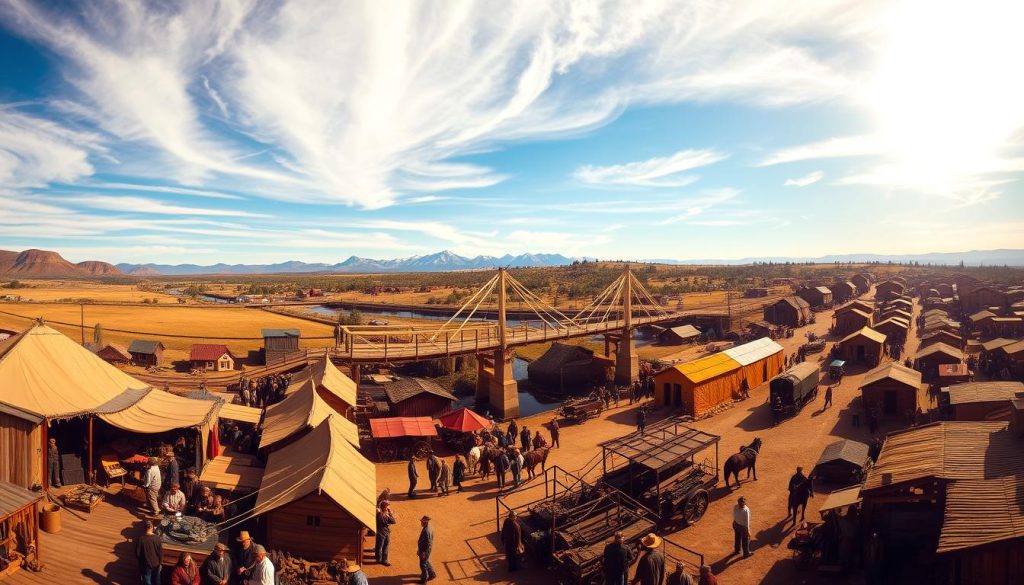
The California Gold Rush changed how people thought about transport and public works. With so many people moving in, companies and governments had to build new systems. These systems helped shape cities in the western United States.
The Need for Transportation Networks
Miners, merchants, and farmers needed good ways to get around. Steamships went back and forth to San Francisco often. Wagon roads helped move goods inland. Everyone wanted better ways to travel.
Construction of Roads and Railroads
People built bridges, turnpikes, and stage routes to connect mining areas. The dream of a fast way from east to west led to the First Transcontinental Railroad. It was finished in 1869. Railroads made moving goods and people much easier.
Development of Urban Centers
Ports like San Francisco grew into big cities as shipping and finance grew. Places like Denver and Boise became cities when they got better transport links. Building roads and trains helped cities grow and stay strong.
- History of the era shows how transport needs redefine economies.
- Investment in infrastructure produced durable civic benefits.
- Expansion of railroads anchored California to national markets.
- Better transport networks encouraged migration and trade.
- These shifts remain central to the region’s urban history.
Cultural Influences of the Gold Rush
The California Gold Rush changed the region in big ways. It brought fast growth, a mix of cultures, and a love for adventure. These changes left a lasting impact on the area’s history and identity.
The Birth of a Unique Western Culture
People from all over came to California. This included Americans, Latin Americans, Chinese, Europeans, Hawaiians, and Indigenous peoples. They mixed their cultures, creating a vibrant community.
Towns popped up quickly with saloons, markets, and theaters. People adapted to the fast pace and new roles. Mark Twain wrote about this era, capturing its bold spirit.
Influence on Literature and the Arts
Writers and artists captured the Gold Rush’s ups and downs. Their work kept the event in the national spotlight. They used photos and paintings to show daily life and the changed landscape.
Stories from the Gold Rush are now in schools and libraries. They highlight the event’s importance by showing different views of ambition and hardship.
Legacy of Folklore and Legends
Stories of “forty-niners” and sudden wealth became part of American folklore. These tales inspired songs, ballads, and plays. They kept memories alive and shaped cultural themes.
These stories show the Gold Rush’s lasting impact on culture. They prove its significance in shaping American identity.
The Role of Technology and Innovation
The Gold Rush brought quick changes in tools, transport, and communication. These changes changed daily work on claims and big patterns of investment and migration in the United States.
Communication Advances
Newspapers in San Francisco and Sacramento shared early reports and job ads, drawing thousands. Merchants like Samuel Brannan used the press to boost business and real estate sales.
The telegraph’s arrival later in the decade made news travel faster between coasts. This meant miners, investors, and shipping agents could react quicker to new chances and risks. These facts show how communication technology led to mass migration.
Miners’ Toolkit
At first, simple tools like gold pans and rocker boxes were used. Sluice boxes then helped find more gold and saved effort.
As surface gold ran out, miners used hydraulic monitors and stamp mills to crush ore. These tools needed more money and knowledge. The changing tools show the practical side of mining technology.
Industrialization’s Impact
- Industrialization made deeper mining more expensive, pushing small operators to sell claims to big firms.
- Investment in steam engines, rail links, and ore-processing plants made production centralized and attracted outside money.
- Environmental effects grew as mechanized methods increased sediment flow and water use, starting early debates over regulation.
These changes show a clear path from simple field tools to big mining companies. The mix of local creativity and wider industrialization led to innovations used worldwide. These historical facts explain how technology changed the landscape and economy during and after the rush.
The Aftermath: Decline of Gold Production
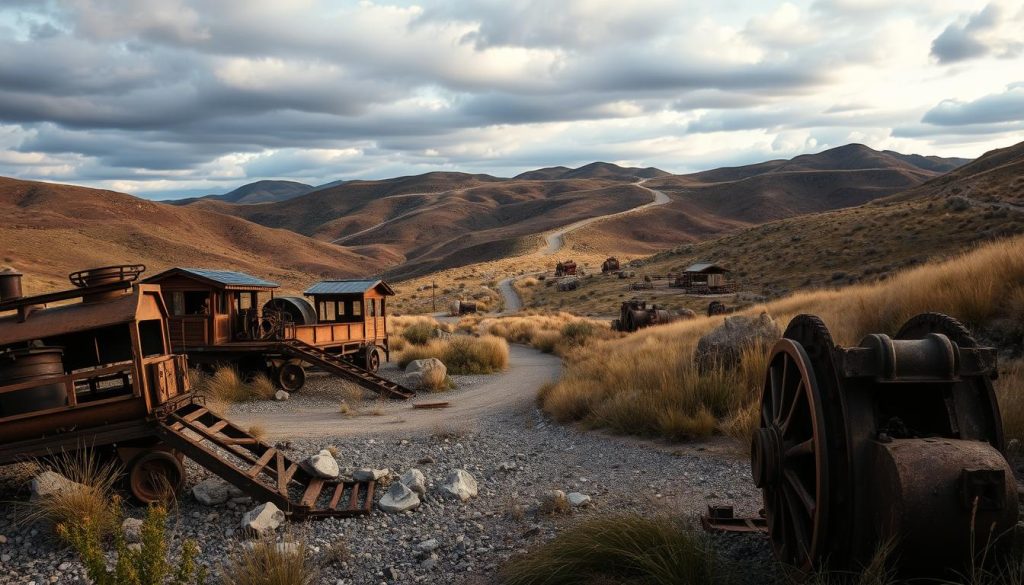
After the gold rush, California’s easy gold days were over. By 1850, most accessible gold was gone. Miners then faced harder work, higher costs, and more competition.
By 1855, many had found new careers. They settled in, leaving the gold rush behind.
- Surface gold was all gone, making small mining unprofitable.
- Big mining needed money and equipment, not individual miners.
- Rules against foreign miners and violence pushed some away.
- New gold finds in places like Australia drew migrants elsewhere.
As mining ended, new jobs emerged. Many miners became farmers, ranchers, or city workers. This helped California’s towns grow.
Landowners worked hard to feed miners and new residents. Farming and raising livestock helped the local economy.
Over time, cities like San Francisco grew. They became centers for shipping, banking, and making things. Boomtowns turned into lasting communities with their own governments.
But, mining’s damage to the environment was lasting. It changed landscapes and waterways.
Experts say the gold rush’s end was good for California’s economy and society. It led to a stronger economy based on farming and other industries. This shaped how people settled and invested for years.
Historical Interpretations of the Gold Rush
The Gold Rush has been seen in many ways over time. Some see it as a key part of American growth, leading to fast economic growth and new buildings. Others point out the harm to Native peoples, racism, and damage to the environment. These views help shape our understanding of that time.
Historiography has changed from stories of success to deeper looks. In the early 1900s, stories focused on building a nation and starting businesses. Now, thanks to University of California Press and Smithsonian, we see more about global migration, work networks, and environmental changes. This shift brings in voices that were once ignored.
Experts debate the Gold Rush’s meaning. Some say it was a major event that changed markets and technology. Others say the benefits came at a high cost, like violence against Native peoples and laws against Chinese miners. These debates are key in today’s history studies.
Today, history is studied in many ways. Environmental historians look at how mining changed landscapes. Social historians explore the lives of women and immigrant miners. Cultural historians study stories from writers like Mark Twain and newspaper reports. These methods help us understand more.
Popular culture also shapes how we remember the Gold Rush. Movies and books often tell stories of adventure and finding gold. Sometimes, they also show the darker side, like greed and injustice. These stories help us see the past in a new light.
Museums and schools teach a balanced view of history. Exhibits combine artifacts and scholarly texts to show both the good and bad. This helps visitors see different sides of history and encourages them to learn more.
- Varied perspectives: economic growth versus social cost
- Shifts in historiography: inclusion of marginalized voices
- Role of film and literature in popular memory
Commemorating the Gold Rush Today
The California Gold Rush left a lasting mark on parks, towns, and museums. Visitors can follow the story through preserved landscapes and collections. These places help us understand the era’s complex history.
Historical Sites and Museums
Important historic sites attract both researchers and tourists. Marshall Gold Discovery State Historic Park marks the spot where history changed in 1848. Shasta State Historic Park shows streets from the time.
San Francisco’s waterfront and old city blocks show how the rush changed cities.
Museums keep artifacts that tell the story. The Smithsonian National Museum of American History and local historical societies have miners’ tools and memorabilia. Exhibits compare California to global gold rushes, showing its impact worldwide.
Events and Festivals Celebrating Gold Rush History
Communities hold reenactments, festivals, and guided walks to bring history to life. Local historical societies show off placer mining and crafts. These events mix fun with serious history lessons.
Festivals include talks by experts and living-history interpreters. They help visitors connect with the past and the lives of 19th-century miners and settlers.
Educational Resources for Understanding the Gold Rush
Universities, state parks, and museums offer educational materials. Teachers can find primary documents, maps, and images for lessons on migration, technology, and environmental change.
Programs focus on the Gold Rush’s impact, including on Native California communities and landscapes. Preservation projects combine cleanup with panels to help visitors understand the era’s significance.
- Visit preserved sites to see landscape and urban change firsthand.
- Explore museum collections for tangible links to daily life in the camps.
- Use educational archives to bring primary sources into the classroom.
Conclusion: Legacy of the California Gold Rush
The California Gold Rush changed the nation’s path. It brought about 300,000 newcomers, sped up statehood, and fueled growth in cities and roads. This influx of people and money brought wealth to some, harm to Native Californians, and environmental changes.
Lasting Impact on American Identity
The era shaped a national image of chance and risk. Stories of quick wealth and bold moves became part of American culture. Yet, historians also highlight the need to balance myths with facts, acknowledging the harm done to Native Californians and the uneven benefits.
Lessons Learned from the Gold Rush Experience
The Gold Rush teaches us about the impact of resource booms. It shows how new technologies and transport can quickly change things. It also warns about the dangers of weak rules leading to environmental harm and social problems.
Reflections on Historical Significance
Scholars today aim to share a more complete story of the Gold Rush. They want to celebrate innovation while also facing the costs. The Gold Rush is a key part of American history, changing demographics, economy, and governance. Its mixed legacy continues to guide discussions on growth, responsibility, and learning from history.
FAQ
What was the California Gold Rush and when did it take place?
The California Gold Rush started when James W. Marshall found gold at Sutter’s Mill in Coloma on January 24, 1848. It lasted until the mid-1850s. The excitement peaked in 1849, and by 1855, about 300,000 people had moved to California.
How quickly did California’s population grow after the discovery?
California’s population grew fast. It went from about 14,000 in 1848 to nearly 100,000 by the end of 1849. By 1853, it reached roughly 300,000. San Francisco grew from a few hundred to tens of thousands in just a few years.
What routes did migrants use to reach California?
Half of the newcomers came by sea. They took long voyages around Cape Horn or crossed the Isthmus of Panama. The other half traveled overland on trails like the California Trail and California Road.
Who were the people who came to seek gold?
People from all over came for gold. This included Americans, Latin Americans, Europeans, Australians, New Zealanders, Hawaiians, and Chinese. Their arrival changed California’s demographics.
What mining methods did prospectors use initially?
Early miners used simple methods like panning, sluicing, and rocker boxes. These methods were easy for individual prospectors to use until the surface gold was gone around 1850.
How did mining technology change as the rush progressed?
As surface gold ran out, miners started using more advanced methods. This included hydraulic mining, mechanized stamp mills, and underground mining. These changes helped big companies more than individual prospectors.
What were the environmental consequences of Gold Rush mining?
Mining caused a lot of damage. It led to erosion, sedimentation, and destruction of forests and rivers. Hydraulic mining reshaped landscapes and caused long-lasting damage to the environment.
How did the Gold Rush affect Native Californian communities?
The Gold Rush was very hard on Native Californians. It led to displacement, loss of food, diseases, starvation, violence, and massacres. This caused a big drop in their population and is now seen as genocide.
What economic effects did the Gold Rush have on the United States?
The Gold Rush boosted the U.S. economy. It increased the money supply and helped the economy recover from downturns. It also created new businesses and industries in California.
Who profited most from the Gold Rush?
While some miners got rich, more people made money by supplying miners. This included steamship and mail companies, merchants, and others. Over time, big mining companies made the most money.
How did the Gold Rush influence California’s political development?
The Gold Rush helped California become a state. It drafted a constitution in 1849 and joined the Union in 1850. It also showed the need for better government in mining areas.
What kinds of law and order emerged in mining districts?
Because of the fast growth, mining areas had to create their own rules. This included claim-staking customs and vigilante groups. Laws like the foreign miners’ tax caused conflict and expulsions.
How did the Gold Rush change infrastructure and transportation?
The Gold Rush led to more roads, ports, and steamship services. It also helped build the First Transcontinental Railroad in 1869. Local roads and bridges connected mining areas to markets.
What social and cultural changes resulted from the Gold Rush?
The Gold Rush created a unique Western culture. It brought together people from different backgrounds, influenced food and religion, and left a lasting mark on American folklore.
What roles did women and families play during the Gold Rush?
Women and families played important roles. Some worked alongside men, while others started businesses or provided services. They helped build stable communities in growing towns.
How did the Gold Rush affect global migration and technology?
The Gold Rush was part of a bigger pattern of migration in the 19th century. It increased the need for faster communication and transport. It also influenced other gold discoveries, like in Australia.
Why did the Gold Rush decline, and what came after?
The Gold Rush declined because of the lack of easy gold, rising costs, and violence. Many miners moved into other areas like agriculture or business. This helped California’s economy grow.
What is the legacy of the California Gold Rush?
The Gold Rush changed California in many ways. It led to statehood, urban growth, and new industries. But it also caused harm, like to Native Californians. Its effects are seen in migration and resource economies today.
Where can the public learn more or visit Gold Rush sites today?
You can learn about the Gold Rush at places like Marshall Gold Discovery State Historic Park. There are also museums and university collections. Guided tours and exhibitions offer a chance to see artifacts and learn more.