The Manhattan Project is presented here as the ultimate guide that explains what the project was, why it mattered, and how it reshaped the modern world’s view of warfare, power, and responsibility.
This introduction promises a structured, evidence-based overview with clear definitions and a navigable timeline focused on the wartime years and the immediate aftermath. It will treat history both as the past and as the documented record that historians analyze.
The guide previews major topics: World War II context, government and military organization, key people, secret sites, basic science, major events, and long-term consequences. It will distinguish popular story versions from the historical record and explain how claims are evaluated.
Readers in the United States can expect a clear road map across 14 sections that move from background to sources, method, timeline, and ethical debates. The focus is on wartime years and the project’s ongoing role in global security.
Key Takeaways
- This guide defines the Manhattan Project and its lasting role in the modern world.
- It offers a structured, evidence-based overview and a clear timeline for the wartime years.
- Readers will learn how popular stories differ from the historical record.
- Sections cover science, people, secret sites, major events, and consequences.
- The guide frames sources and methods used to evaluate claims.
What the Manhattan Project Was and Why It Changed the World
The Manhattan Project was a WWII-era U.S.-led program that combined government, military, and scientific work to develop atomic weapons.
This project changed the world by altering international relations and military strategy. It made scientific power a central moral and political issue in modern history. Nations rearranged alliances and deterrence thinking around the existence of nuclear arms.
Definition, meaning, and role in modern study
The guide treats history as a disciplined study of the past that relies on evidence, context, and causation rather than simplified storytelling. It uses the noun “record” to mark documents, archives, and corroborated accounts that support claims.
From “a story” to a documented record of past events
Not every story about the project is a verified account. Researchers separate narrative from record by checking sources, applying source criticism, and tracing provenance.
- Sources: primary documents and artifacts.
- Historiography: how interpretations evolve.
- Periodization: placing events in broader eras.
World War II Context: Events That Triggered the Race
The pressures of a worldwide war compressed normal timelines and pushed governments toward heavier risk-taking. Placed within the WWII time period, the Manhattan Project emerged as an urgent, mission-driven effort. Leaders evaluated threats fast and treated long-term research as immediate action.
Global time period and wartime decision-making
Across the globe, military setbacks and intelligence reports shortened decision cycles. Nations moved from study to rapid deployment. This shift changed how resources and authority were used during the period.
Why the project became a national priority for the United States
The U.S. made atomic work a top priority because strategic concerns and signals from abroad suggested rivals could gain an edge. Federal capacity scaled in months, not years, altering american history and government practice.
- Secrecy and centralization: rapid procurement replaced peacetime norms.
- Risk tolerance: acceptable danger rose as events demanded speed.
- Example: centralized control, classified labs, and tight timelines guided decisions.
Early choices about where to work, who would lead, and what tradeoffs to accept shaped the project’s later role in global security and the past debates that follow.
American History at a Turning Point: Government, Military, and Science
The U.S. built a new model that fused laboratory science with military project management to meet urgent wartime goals.
Organizing secrecy, funding, and large-scale work
Military oversight set clear chains of command while civilian labs kept technical control. Funding flowed through emergency channels, fast contracts, and prioritized procurement to accelerate work.
Secrecy relied on strict classification, need-to-know access, and compartmentalization. These practices protected plans and kept production timelines intact.
Structures that created records
The program produced memos, directives, lab notes, contracts, and shipping logs. Those documents form the primary record that later scholars use.
- Staffing and contracts: rapid hiring, engineering teams, and heavy industry partners.
- Decision chains: streamlined approvals for speed and control.
- Science as applied work: engineering, manufacturing, and operations under tight time limits.
For the study of american history, this moment shows how federal power expanded and how bureaucratic sources enable reconstruction of events—even when some files remain classified or lost.
Key People Behind the Manhattan Project
Key individuals across labs, factories, and military posts shaped how the project moved from idea to reality. The effort combined scientific leadership, military management, and often-overlooked labor to meet urgent goals.
Scientific leadership and laboratory culture
Top physicists set research priorities and led teams that combined theory and experiment. Labs prized collaboration but operated under strict secrecy.
Example: a lead physicist directing calculations while colleagues ran experiments and shared results in closed groups.
Military oversight and operational control
Military commanders enforced schedules, security, and accountability. Operational control shaped priorities and pushed rapid scale-up across sites.
The often-overlooked workforce
Engineers, technicians, administrators, and industrial laborers did the daily work that made design into production.
- Scientific leaders and lab teams
- Engineers and scale-up managers
- Technicians, clerks, and factory workers
The historical record preserves official roles well but often misses informal culture and marginalized voices. Later sections will explain how scholars study those gaps in the past and the project’s wider record.
The Sites and Infrastructure That Powered the Program
Distributed facilities let planners protect key research while scaling up mass production away from main labs. The project separated small research hubs from large production plants to manage risk, capacity, and secrecy.
How research hubs and production facilities were distributed
Research centers concentrated specialized teams and sensitive experiments. Large-scale plants handled heavy chemistry, metallurgy, and assembly at distance.
Why: separation reduced the chance that a single breach would compromise both ideas and output. It also allowed contractors to focus on capacity while scientists refined designs.
Security, compartmentalization, and everyday life
Compartmentalization limited information flow. Teams knew only what they needed to do their jobs.
Logistics ran on tight schedules. Materials moved under escort, communications were restricted, and transport faced wartime limits.
What daily life looked like
Residents lived in guarded towns, used badges, and accepted mail controls. Routines balanced long shifts and strict supervision.
Example day: a worker arrives with ID, passes a checkpoint, completes assigned tasks without full project context, and leaves under curfew.
- Maps and contracts record construction and site choices.
- Security procedures left formal files historians use as primary record.
- Local traces—housing blocks, payroll ledgers, and roads—link covert work to wider wartime events.
The built infrastructure fit into a global conflict by moving vital production out of densely populated centers. Even hidden facilities were part of the wider wartime system of supply, labor, and strategic planning.
Science Explained: How the Atomic Bomb Was Developed
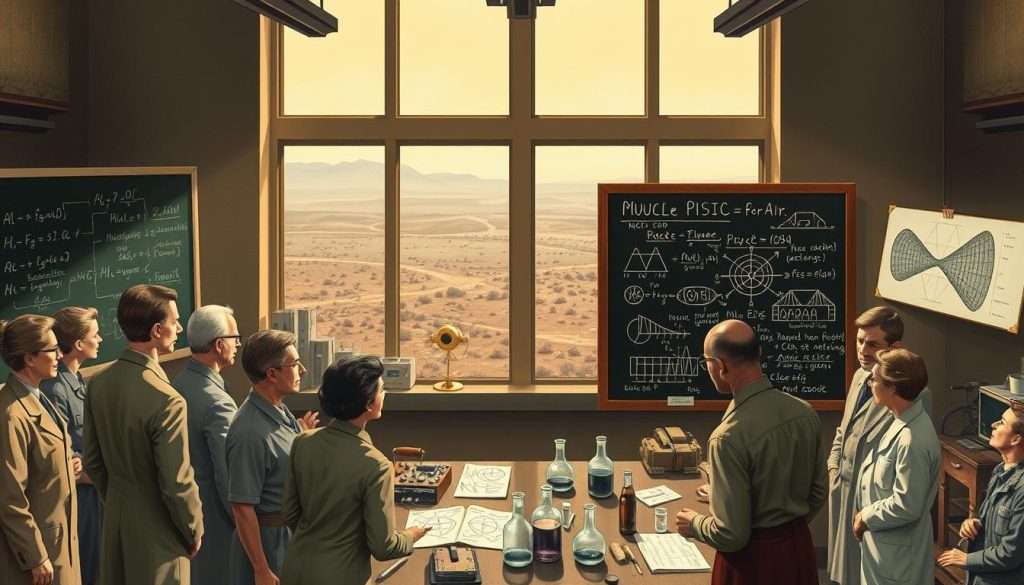
Science in the Manhattan Project turned abstract ideas into machines built under strict limits of time and secrecy.
The section explains core concepts in plain terms. It defines critical ideas like fission (splitting an atom to release energy) and critical mass (the amount needed for a sustained chain reaction). These definitions focus on meaning, not equations.
Core concepts for non-specialists
Work began with small experiments to prove a concept. Scientists measured neutron behavior, tested material purity, and tracked timing. Simple measurement errors or impure metals could stop a device from working.
From experiments to engineered systems
Proof of concept is one thing; repeatable production is another. Engineers solved machining tolerances, assembly procedures, and supply-chain limits so devices worked reliably in the field.
Testing, risk, and wartime limits
Testing served scientific and operational goals. Trials reduced uncertainty, but time pressure raised acceptable risk. Commanders and scientists negotiated where scientific judgment ended and military decisions began.
- Examples: material purity standards, timing mechanisms, and measurement checks that determined outcomes.
- Sources scholars use: lab notebooks, technical reports, and test logs reveal choices and errors.
- Role of risk: safety and criticality concerns shaped procedures during those intense years.
Timeline and Major Past Events of the Manhattan Project
A phase-based narrative shows cause and effect across research, production, and policy decisions.
Early planning years and rapid scaling
Initial lab work in the early years focused on proof-of-concept experiments. Within months, leaders moved from small teams to large contracts.
Facilities multiplied. Scientific priorities became industrial commitments as metallurgy plants and pilot reactors were built.
Breakthrough moments that shaped outcomes
Key technical wins—neutron measurements, enrichment processes, and implosion design—accelerated progress. Organizational shifts, like centralized project management, cut delays.
The final push from development to deployment
The last months combined testing, mass production, and coordinated orders. Logistics and command decisions synced research outputs with operational timetables to meet a single day of action.
Immediate aftermath and new global realities
In the days after deployment, the world entered a new diplomatic period. Nuclear capability reshaped strategy and international relations.
Timelines in the historical record are built by cross-checking memos, orders, technical milestones, and announcements so past events form a coherent, verifiable sequence.
History as a Discipline: How Scholars Study the Manhattan Project
Studying the Manhattan Project means tracing choices in records, testing claims against reliable material, and building explanations that match the evidence.
Historical method and research questions
The research method starts with clear questions: what happened, why decisions occurred, and what followed. Scholars collect documents, evaluate bias, and synthesize findings to answer those queries.
Periodization: placing the project within broader eras
Periodization organizes change into useful blocks: wartime urgency, the early Cold War, and shifts in state science. These labels help compare causes across period boundaries and mark important time markers.
How narratives are built from evidence
Narratives emerge by linking validated statements from primary sources into coherent stories. Interpretation rests on what the sources support, not on appealing language or easy labels.
- Example: a research question might ask how secrecy shaped outcomes.
- Scholars examine word choice and framing—race, program, project—to test meaning.
- Historiography is the ongoing conversation that will be explored next.
Sources and Evidence: What Counts as Proof in This Story
Not all records carry the same weight; careful standards separate strong proof from unreliable claims. Scholars working on the Manhattan Project use clear criteria to decide which materials support an account and which do not.
Primary sources and practical categories
Primary sources come from the period studied: government directives, lab reports, photographs, audio recordings, eyewitness accounts, letters, and artifacts. These items form the backbone of the record used in careful study.
Secondary sources and interpretation
Secondary sources analyze or synthesize primary material. Whether a work is primary or secondary can change with the research question. For one study a memo may be a primary object; for another, it serves as evidence cited in a later analysis.
Testing authenticity and bias
Source criticism uses external checks (authorship, date, alteration) and internal checks (consistency, omissions, motive). Researchers cross-check items against other sources to judge reliability.
Repositories and access
Archives, libraries, museums, and growing digital collections determine what scholars can study. The word “source” is a starting point — not a guarantee of truth — and the noun marks material that must be tested before it proves a claim.
- Examples: lab notebooks confirm measurements; photographs fix places and dates.
- Example: a veteran’s diary may be primary for personal experience but secondary for technical data.
- Practical note: preservation and access shape future study of the project.
Historiography: How Interpretations Have Changed Over Time
Interpretation of the Manhattan Project has shifted as new archives, methods, and questions appear. Historiography tracks those changes and shows why consensus can change when fresh material alters the narrative.
Competing approaches and what they stress
Different schools ask different questions. Positivist work focuses on documents and technical detail. The Annales approach looks at long-term structures and social context. Marxist studies highlight political economy and labor. Postmodern critique questions narrative authority and meaning.
Silences, classification, and gaps in the record
Some topics stayed hidden because files were classified or never created. Those silences shaped early accounts until declassification filled gaps. A clear example: when procurement logs and memos were released, scholars revised claims about decision timing and responsibility.
- Define what sources support an argument.
- Ask what is omitted or still classified.
- Test assumptions that shape meaning across time.
Readers should practice a simple checklist when evaluating claims: What sources are used? What is missing? What assumptions steer the account? This meta-analysis — a form of history history — links scholarly debate to public policy and civic understanding long after the wartime period.
The Human Impact: Life, Ethics, and the Medical History of Radiation
Understanding the medical aftermath and moral debates gives fuller meaning to the project’s technical record. Attention to life, health, and daily experience completes the past beyond engineering milestones.
Health consequences and what later research revealed
Early knowledge about radiation effects was limited. Workers and nearby residents faced exposures that later studies linked to cancer, thyroid disease, and other chronic conditions.
Over subsequent decades, medical history research refined dose-response models, traced long-term outcomes, and improved treatment protocols. That evolving knowledge changed safety practice and compensation policy.
Ethical debates that still shape public understanding
Debates center on necessity, proportionality, civilian harm, informed consent, secrecy, and accountability. These questions persist because evidence and framing can produce different moral conclusions.
Example: an account emphasizing military urgency may judge decisions differently than a study that foregrounds civilian medical testimony. Both uses of sources change the ethical interpretation.
- Sources: medical studies, testimony, official investigations.
- Method: cross-check clinical records with archival documents for credible claims.
- Role: rigorous methods clarify the human toll and guide policy responses.
Centering lived experience—workers, nearby communities, and affected populations—keeps the study grounded in evidence and humane meaning.
Public Memory and Institutions Preserving the Past
Curators translate material culture into stories that guide what people recall about the past. Museums select objects, conserve them, and write labels that connect artifacts to broader social meaning.
How museums turn objects into national narratives
Institutions like the Smithsonian’s National Museum of American History position collections as public trust. They use artifacts—text panels, catalogs, and displays—to create accessible narratives.
Concrete examples show the process. The Greensboro Woolworth lunch counter serves as civil rights evidence. Conserving Dorothy’s Ruby Slippers and collecting September 11 artifacts illustrate curatorial choices that shape what the public remembers.
Education, exhibitions, and why preservation matters for future study
Museums act as living sources for future study. Exhibition texts, educational programs, and preserved objects enter the documentary record and expand what scholars can test and reinterpret.
- Topics such as science and innovation, political participation, and social movements help visitors navigate complex stories.
- Framing affects word choice and emphasis; it can make one account feel like the national story among many possible histories.
- Preservation protects evidence against loss and enables new research generations to revisit the record.
Conclusion
Few subjects show the link between laboratory work and national decision-making as clearly as the Manhattan Project.
Readers are reminded that this guide treats the project as a subject where science, government power, and wartime urgency met. Claims are judged by evidence, not repetition, and that method-first approach shapes credible accounts.
History history matters: how scholars build, revise, and teach narratives affects public understanding and policy. Historiography continues as archives open and new analyses reshape past interpretations.
The project’s legacy reaches the world beyond its wartime moment. Preservation, scholarship, and public education will decide what the next age learns, and families across generations inherit that record.
Careful word choice—how one uses the noun “history” versus “a history”—still guides what readers accept. Close reading and tested sources keep the conversation honest and useful.